
"E" in Your Food — All E Numbers Harmful to Health
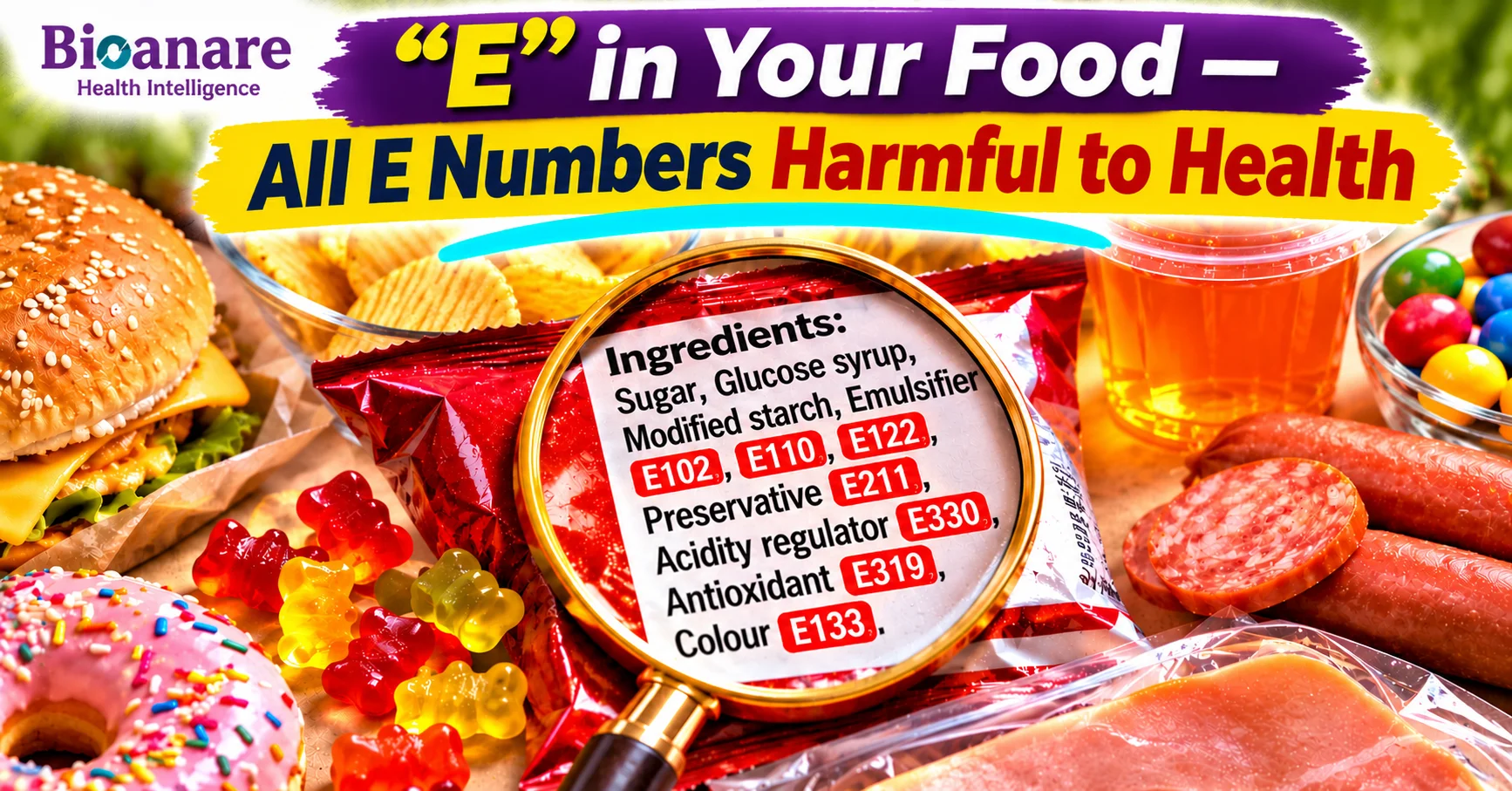
You flip over a food package and see: E102, E211, E951, E407. What are these? Are they safe? Should you worry?
E numbers are the European Union coding system for food additives — substances added to food to preserve it, color it, sweeten it, thicken it, or enhance its flavor. Some are harmless. Some are vitamins. But many are industrial chemicals with serious documented health effects.
This is a complete guide to the E numbers you should avoid.
Upload your blood test to Bioanare — free 7-day trial, no credit card required
How to Read the List
The E number system covers hundreds of additives. Not all are dangerous. This article covers only those with documented health risks — meaning studies, regulatory bans in multiple countries, or strong scientific consensus linking them to harm.
Risk categories used in this guide:
- 🔴 Avoid — linked to cancer, organ damage, neurological effects
- 🟠 Caution — linked to hyperactivity, allergic reactions, immune disruption
- 🟡 Sensitive groups — problematic for children, people with asthma, or those with specific conditions
Artificial Colors
Artificial dyes provide no nutritional value and exist solely to make processed food look more attractive.
Linked to hyperactivity in children (the dye that triggered the UK's "Southampton Six" study), asthma exacerbation, skin rashes, and migraines. Banned from children's foods in several countries. Still widely used in soft drinks, sweets, and packaged snacks.
Part of the Southampton Six. Linked to hyperactivity in children. Banned in the US, Canada, Japan, and Norway. Permitted in the EU with a warning label.
Part of the Southampton Six. Linked to hyperactivity, allergic reactions, and kidney tumors in animal studies. Requires an EU warning label: "may have an adverse effect on activity and attention in children."
Linked to hyperactivity and allergic reactions. Banned in the US, Sweden, Norway, and Japan. Part of the Southampton Six.
Part of the Southampton Six. Hyperactivity in children and allergic reactions in aspirin-sensitive people. Banned in the US and Norway.
One of the most common food dyes in the world. Part of the Southampton Six. Studies link it to hyperactivity, DNA damage, and potentially carcinogenic breakdown products. The EU requires a warning label; still unrestricted in the US.
Can cause anaphylactic reactions. Banned in the US and Australia.
Linked to nausea, vomiting, high blood pressure, and brain tumors in animal studies at high doses.
Kidney tumors in animal studies. Can cause allergic reactions. Banned in several European countries.
Banned in the US, Canada, Japan, Norway, Sweden, and Finland. Can cause asthma and allergic reactions.
Linked to allergic reactions and hyperactivity. Banned in the US, Canada, and several other countries.
Used almost exclusively on kippers in the UK. Restricted or banned in most countries outside the EU.
Linked to hyperactivity and allergic reactions. Banned in the US, Canada, Japan, Norway, Sweden, and Finland.
Preservatives
Preservatives prevent spoilage, but several work by being toxic to microorganisms — and they don't stop at bacteria.
When sodium benzoate combines with vitamin C (ascorbic acid, E300), it forms benzene — a known human carcinogen. Used in soft drinks, pickles, sauces, and fruit juices. E211 is part of the Southampton Six. Linked to ADHD, DNA damage, and mitochondrial dysfunction. The FDA acknowledges the benzene risk but has not banned E211.
Ethyl paraben, propyl paraben, and related compounds. Linked to endocrine (hormone) disruption; they mimic estrogen, which is associated with breast cancer growth. Food-use parabens enter the same hormonal pathways as cosmetic ones. Propylparaben (E217) is banned in the EU.
Trigger asthma and severe allergic reactions in sulfite-sensitive people (around 1 in 100, higher in asthmatics). Used in wine, dried fruit, shrimp, and processed foods. Destroys vitamin B1 (thiamine). The FDA requires labeling above 10 ppm.
Used in cured and processed meats (bacon, ham, hot dogs, salami). When cooked at high heat, nitrites form nitrosamines — potent carcinogens. The WHO's IARC classifies processed meats as a Group 1 carcinogen. Children are particularly vulnerable.
Synthetic antioxidants that stop fats going rancid. BHA is a possible human carcinogen (IARC); BHT is linked to liver and kidney damage and thyroid disruption in animal studies. Still used in cereals, chips, chewing gum, vegetable oil, and baked goods.
Artificial Sweeteners
These zero-calorie substitutes were meant to help people eat less sugar. The science tells a more complicated story.
Common in diet drinks and "sugar-free" products. Studies link long-term exposure to immune disruption, organ damage (liver and kidney in animals), mood disorders, and potentially cancer. Long-term human safety data is limited.
Breaks down into methanol, formaldehyde, and formic acid. Linked to headaches, dizziness, neurological symptoms, mood disorders, and seizures in sensitive people. In 2023 the WHO's IARC classified it "possibly carcinogenic to humans" (Group 2B). People with PKU must avoid it entirely.
Banned in the United States since 1969 due to evidence of bladder cancer in animal studies. Still permitted in over 100 countries. Classified as a possible carcinogen.
The oldest artificial sweetener. Linked to bladder cancer in animal studies. Concerns remain about its effects on the gut microbiome and glucose tolerance. Can cross the placenta during pregnancy.
Reduces beneficial gut bacteria, impairs insulin response, and generates chlorinated compounds when heated. A 2023 study found the metabolite sucralose-6-acetate is genotoxic — it damages DNA.
Generally considered safe in small amounts, but a large 2023 study in Nature Medicine linked high blood erythritol to increased heart attack and stroke risk. Industrial erythritol is far more concentrated than the trace amounts in fruit.
Emulsifiers and Thickeners
Extracted from red seaweed; used in dairy, infant formula, deli meats, and "natural" processed foods. Promotes intestinal inflammation, disrupts the gut microbiome, and may promote cancer growth. The EU banned it from infant formula in 2018; it is still permitted in US formula.
An emulsifier in ice cream and baked goods. In mice it disrupts the intestinal mucus barrier and promotes gut inflammation, obesity, metabolic syndrome, and colon cancer. Associated with hypersensitivity reactions.
A thickener in many processed foods. A 2022 human trial in Gastroenterology found it altered gut bacteria and promoted low-grade inflammation, similar to polysorbate 80.
Flavor Enhancers
Enhances umami taste. Glutamate excess contributes to excitotoxicity — overstimulation of nerve cells. Sensitive individuals report headache, flushing, chest pain, nausea, and weakness. MSG stimulates appetite and blunts satiety, and is associated with obesity.
Always used together and always combined with MSG (E621) to amplify its flavor effect. Derived from fish, meat, or yeast. Those who react to MSG will react to these as well.
Anti-Caking Agents
Aluminium-based anti-caking agents. Aluminium is a neurotoxin, and brain accumulation is strongly associated with Alzheimer's disease. Found in table salt, powdered foods, coffee creamers, and spice blends. The precautionary principle suggests limiting exposure.
Bleaching Agents
Used to bleach flour and strengthen dough. When baked it breaks down into semicarbazide and urethane — both potentially carcinogenic. Banned in the EU, the UK, Australia, Singapore, and most of Europe, but still permitted in the US. Also used to make yoga mats and shoe soles.
How to Avoid Harmful E Numbers
Read labels. Even in products marketed as "healthy," "natural," or "organic," harmful additives appear. The phrase "natural flavors" is not an E number but can mask glutamate derivatives.
Shop the perimeter. Fresh produce, unprocessed meat, eggs, and whole grains have no ingredient list because they don't need one.
Choose whole foods. The more processed a food product, the more additive codes it carries.
Cook from scratch. You control what goes in.
Children are more vulnerable. Their blood-brain barrier is less developed, their body mass is lower relative to dose, and many additives — especially dyes and preservatives — have specifically documented effects on children's behavior, development, and long-term health.
The food industry has added these substances to our food supply for decades under the assumption that "the dose makes the poison." But the dose in one product, multiplied by thousands of products consumed daily across a lifetime, tells a different story. Your body deserves better.
Bioanare provides educational health information only. This is not a medical diagnosis. Always consult a qualified healthcare professional before making any health decisions.
← Back to all articles