
How to Read Blood Test Results Without Medical Knowledge
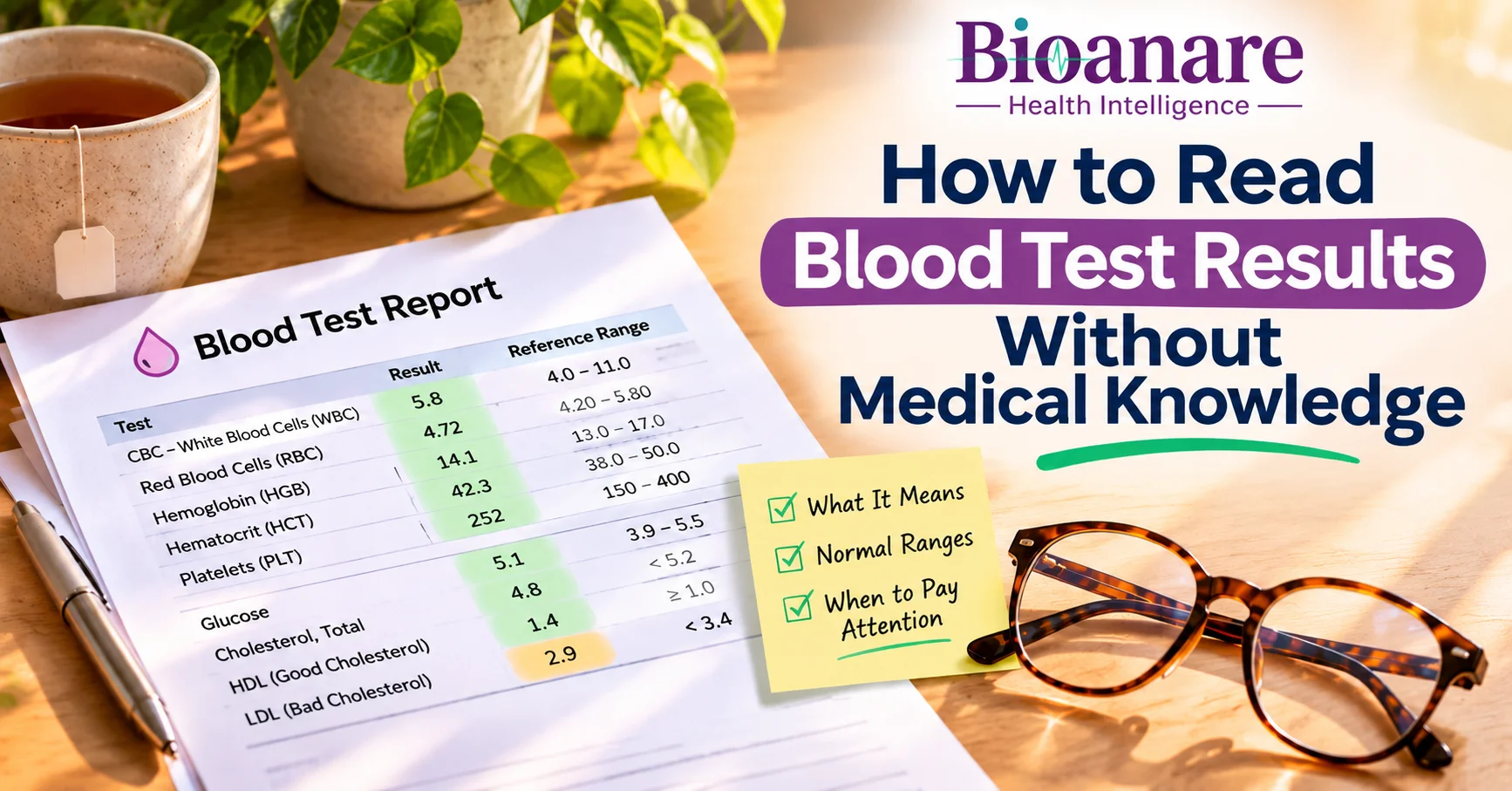
A blood test report can look intimidating: columns of abbreviations, numbers, units you've never seen, and the occasional alarming "H" or "L" in the margin. But you don't need a medical degree to understand the structure of your results. Once you know what each column means and which markers matter, most reports become far less mysterious. Here's a practical, plain-English walkthrough.
Upload your blood test to Bioanare — free 7-day trial, no credit card required
1. Understand the four columns
Almost every lab report has the same basic layout:
- Test name — the marker being measured, often abbreviated (e.g. "Hb" for haemoglobin, "ALT" for a liver enzyme).
- Your result — the actual number for your sample.
- Units — how the result is measured (e.g. g/L, mmol/L, ng/mL). Units matter: the same marker can be reported in different units in different countries, so a "normal" number in one unit may look alarming in another.
- Reference range — the range considered typical for a healthy population. Your result is compared against this.
2. What "reference range" really means
The reference range is the single most misunderstood part of a blood test. It's not a line between "healthy" and "sick." It's the range into which roughly 95% of a healthy reference population falls — which means, by definition, about 1 in 20 perfectly healthy people will have a result slightly outside it. A value just past the edge of the range is usually far less significant than a value far outside it.
Reference ranges also vary by laboratory, by analyser, and by your age and sex. That's why you should always read your result against the range printed on your report, not a number you found online.
3. Decode the flags
The letters beside a result — "H" (high), "L" (low), or sometimes "*", "A" (abnormal), or a result in bold or red — simply mean the value sits outside the reference range. A flag is a prompt to look closer, not a diagnosis. A single flagged marker with everything else normal often means very little; several related markers flagged together is more meaningful.
4. Know the common panels
Most routine testing falls into a few groups:
- Complete blood count (CBC/FBC). Measures red cells, white cells, and platelets. Haemoglobin and related indices screen for anaemia; white cells reflect infection and immune activity; platelets relate to clotting.
- Metabolic / renal panel. Sodium, potassium, urea, and creatinine reflect kidney function and hydration. eGFR estimates how well the kidneys filter.
- Liver function tests. ALT, AST, ALP, bilirubin, and albumin reflect liver health and function.
- Lipids. Total cholesterol, LDL, HDL, and triglycerides relate to cardiovascular risk — and are more nuanced than "high = bad."
- Glucose / HbA1c. Blood sugar now (glucose) and the average over the past three months (HbA1c), used to screen for and monitor diabetes.
- Thyroid. TSH, and sometimes free T4 and T3, reflect how the thyroid is working.
5. Read markers together, not in isolation
The real skill in interpreting blood tests is seeing patterns across markers. A low haemoglobin means one thing alongside low ferritin (likely iron-deficiency anaemia) and something quite different alongside normal iron and a high mean cell volume. Markers tell a story collectively; read in isolation, any one of them can mislead.
6. Factor in timing and preparation
Results shift with fasting, hydration, recent exercise, time of day, medications, and even a recent cold. Glucose and lipids in particular are affected by whether you fasted. If a single value looks off, a repeat test under the right conditions is often the most sensible next step.
7. Know when a number actually matters
Ask three questions of any abnormal result: How far outside the range is it? Is it part of a pattern with related markers? And has it changed from previous tests? A result that is barely out of range, isolated, and stable over time is usually reassuring. One that is far out of range, trending in the wrong direction, or clustered with other abnormalities deserves a conversation with your doctor.
Let Bioanare do the connecting for you
Even with this framework, pulling dozens of markers into a coherent picture — in the right units, against the right ranges, in plain language — takes time and knowledge most people don't have. That's what Bioanare is built for: upload your report and get a clear explanation of what each result means for you.
Bioanare provides educational health information only. This is not a medical diagnosis. Always consult a qualified healthcare professional before making any health decisions.
← Back to all articles