
How to Read a Food Label: Hidden Ingredients Most People Miss
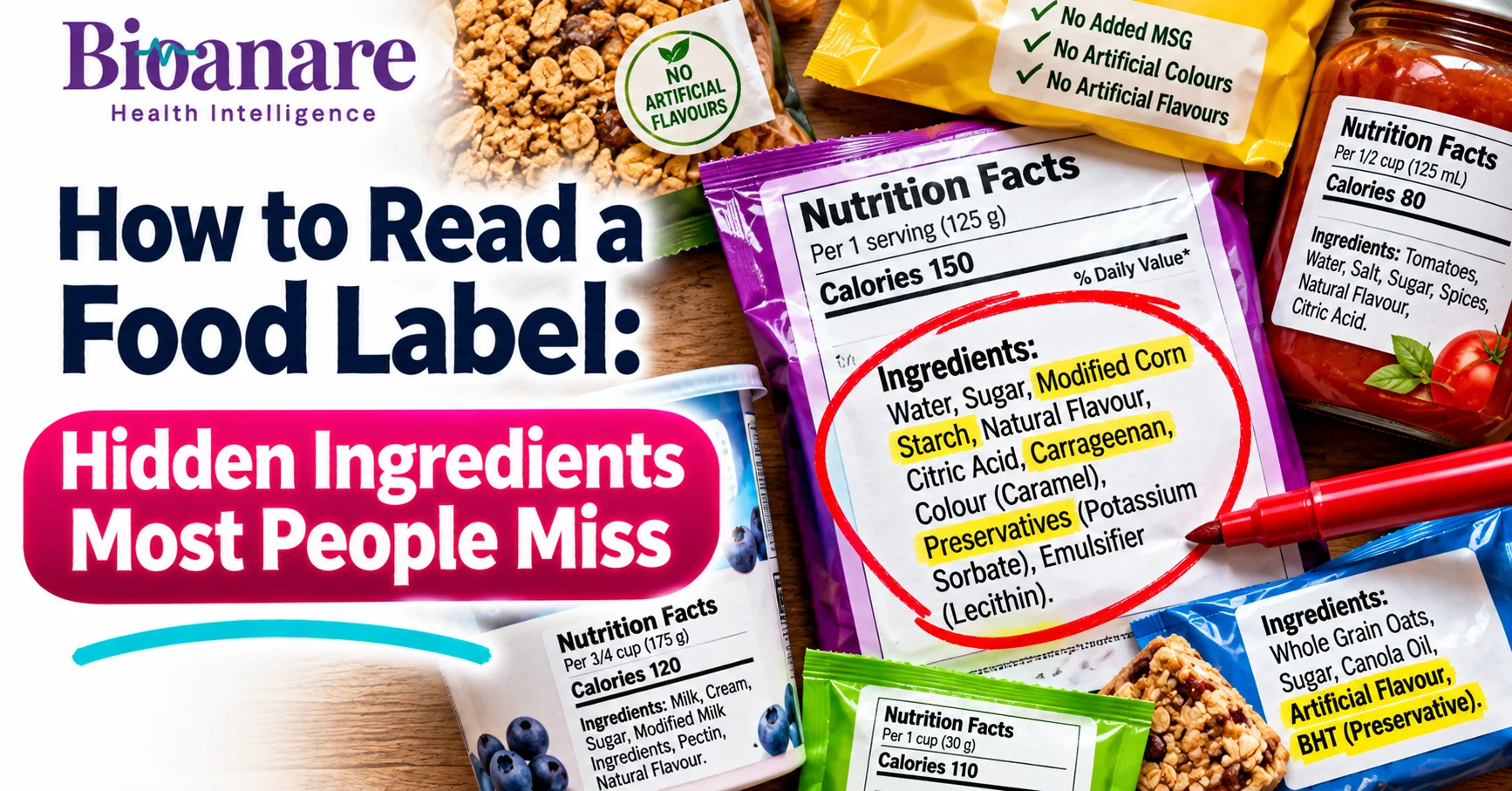
Food labels are designed by marketing departments. The front of the package — "natural," "low fat," "no added sugar," "wholesome" — is advertising. The back is where the truth is. And even the back requires knowing how to read it.
Upload your blood test to Bioanare — free 7-day trial, no credit card required
The Ingredient List: Most Important, Most Overlooked
Rule 1: Ingredients are listed by weight, most to least. The first three to five ingredients are what the product is primarily made of. If the first ingredient is sugar (or one of its many aliases), that's what you're mostly eating.
Rule 2: Sugar has 56+ names. When manufacturers want to avoid "sugar" appearing at the top of the list, they use multiple sweeteners so each one appears lower. Look for: glucose, fructose, maltose, dextrose, corn syrup, high-fructose corn syrup, cane juice, brown rice syrup, coconut sugar, agave, barley malt, molasses, sucrose, lactose, maltodextrin, and more.
Rule 3: "Natural flavors" can mean almost anything. The FDA definition of "natural flavor" is broad enough to include hundreds of substances derived from natural sources — including extracts, fermentation products, and processing aids.
Rule 4: "No preservatives" doesn't mean no additives. Products can avoid preservatives while containing color enhancers, texture agents, flavor boosters, and emulsifiers.
Common Additives to Know
Sodium nitrite / sodium nitrate: Used in processed meats (bacon, deli meats, hot dogs). Can form nitrosamines during high-heat cooking, which are classified as probable carcinogens.
BHA / BHT: Synthetic antioxidants used to preserve fats. BHA is listed as a possible human carcinogen by IARC.
Carrageenan: Thickening agent derived from seaweed, used in dairy alternatives, deli meats, infant formula. Some research associates it with gut inflammation.
Potassium bromate: Flour improver banned in the EU, Canada, and many countries but still permitted in the US. Associated with kidney and thyroid tumors in animal studies.
Titanium dioxide: White coloring used in candies, gum, some dairy. The EU banned it in food in 2022 due to genotoxicity concerns. Still permitted in the US.
Marketing Claims vs. Reality
"Natural": No legal definition in the US for most foods. Meaningless.
"Low fat": Usually replaced fat with sugar or modified starch to maintain palatability.
"No added sugar": May still contain very high amounts of natural sugars, or use artificial sweeteners.
"Whole grain": The first ingredient must be a whole grain to be truly whole grain dominant. "Made with whole grain" can mean very little whole grain.
Bioanare provides educational health information only. This is not a medical diagnosis. Always consult a qualified healthcare professional before making any health decisions.
← Back to all articles