
How to Read an Ultrasound Report
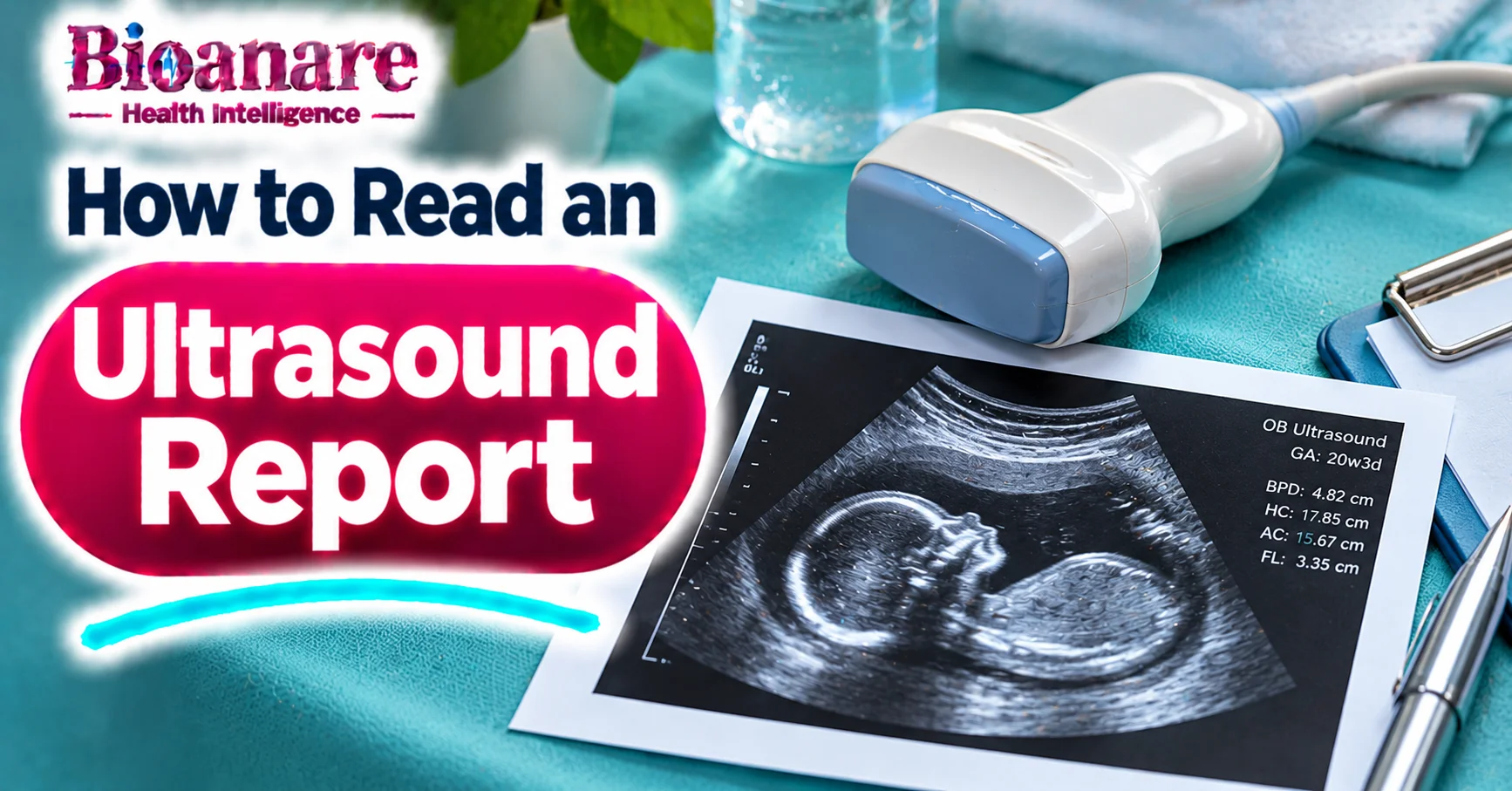
Ultrasound is one of the most common medical imaging tests — used for abdominal organs, thyroid, heart (echocardiogram), blood vessels, and obstetric scans. Here's how to read the report.
Upload your blood test to Bioanare — free 7-day trial, no credit card required
Key Ultrasound Terms
Echogenicity: How bright or dark an area appears on ultrasound. - Hyperechoic (echogenic): Bright — typical of fat, bone, or some masses - Hypoechoic: Darker than surrounding tissue — often fluid-containing or some solid masses - Anechoic: Completely black — indicates fluid (cysts, blood vessels, bile) - Isoechoic: Same echogenicity as surrounding tissue — often hard to distinguish
Homogeneous: Uniform texture — generally a good sign for organs.
Heterogeneous: Mixed texture — warrants further investigation.
Cyst: Fluid-filled sac. Simple cysts (anechoic, smooth walls) are almost always benign. Complex cysts (with internal echoes or irregular walls) need further evaluation.
Nodule: A small, well-defined mass. Thyroid nodules are very common — most are benign, but size and characteristics guide follow-up.
Free fluid: Fluid not in a vessel or organ — abnormal in most contexts (except ovulation); can indicate bleeding or infection.
TRUS / TVS: Transrectal / transvaginal ultrasound — provides better images of prostate or pelvic organs.
Obstetric Ultrasound Terms
Gestational sac, crown-rump length, BPD (biparietal diameter), EFW (estimated fetal weight) — all used to date the pregnancy and assess fetal development.
Bioanare provides educational health information only. This is not a medical diagnosis. Always consult a qualified healthcare professional before making any health decisions.
← Back to all articles