
Is Your Olive Oil Real? How to Spot Fake Extra Virgin
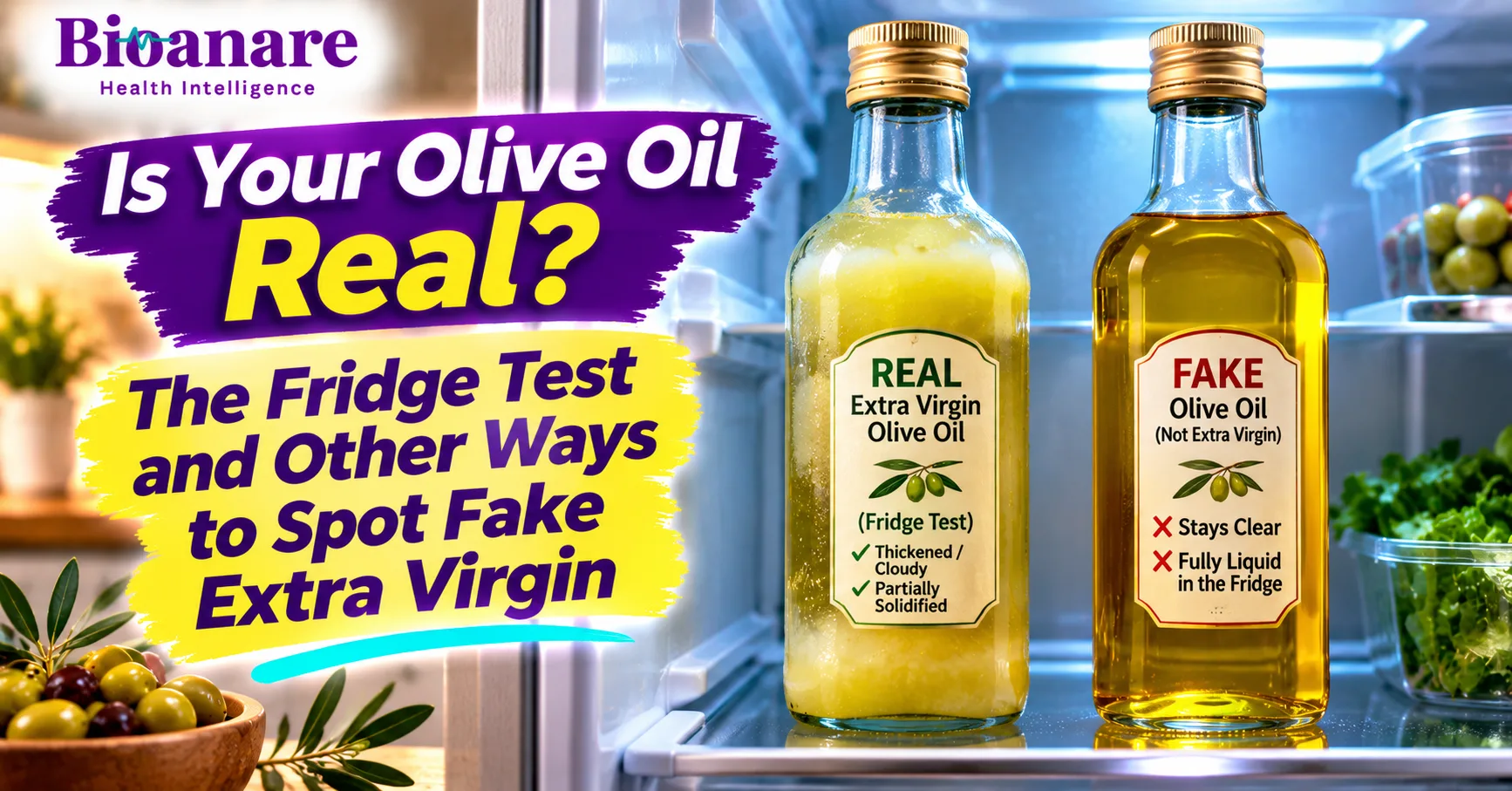
You've probably seen the advice: put your olive oil in the fridge. If it solidifies, it's real. If it stays liquid, it's fake. It's been shared millions of times on social media, promoted by Dr. Oz, repeated in kitchens across the world.
There's one problem: it's not true.
Upload your blood test to Bioanare — free 7-day trial, no credit card required
Why the Fridge Test Fails
Extra virgin olive oil (EVOO) is predominantly monounsaturated fat — oleic acid — which does solidify at cold temperatures. That part is accurate. But here's what the fridge test ignores:
- Refined oils can also solidify. Highly refined olive oil — a lower-grade product with stripped nutrients — can freeze in a refrigerator. So can some canola oils. Solidification does not equal authenticity.
- Real EVOO may not fully solidify. Depending on the variety, harvest time, and fatty acid profile, a genuine high-quality extra virgin olive oil may remain partially liquid in a standard refrigerator set at 4–5°C.
- UC Davis tested it and it failed. Researchers at the UC Davis Olive Center ran controlled trials and concluded the fridge test cannot distinguish authentic EVOO from refined, blended, or adulterated oils. The test has been debunked in peer-reviewed research.
The Actual Scale of the Problem
The olive oil fraud problem is very real — just not solved by a home freezer test.
- A 2010 UC Davis study found that 69% of imported oil labeled "extra virgin" did not meet the standards for extra virgin grade
- Estimates from industry investigators put the percentage of fraudulent or adulterated olive oil on global shelves as high as 70–80%
- Common adulterants include: sunflower oil, hazelnut oil, soybean oil, and lower-grade refined olive oils — all colored with chlorophyll and flavored to mimic EVOO
- Italian olive oil fraud is a documented organized crime issue — the profit margins rival drug trafficking
How to Actually Verify Your Olive Oil
1. Check the harvest date — not just the best-by date
Real EVOO lists the harvest year. Best-by dates can be 24 months from bottling — but if no harvest date is listed, you don't know how old the oil actually is. Freshness matters enormously: phenolic compounds (the health-giving antioxidants in real olive oil) degrade over time.
2. Look for protected designations (PDO/DOP)
In Europe, PDO (Protected Designation of Origin) or DOP certification means the oil was produced, processed, and packaged in a specific region under regulated conditions. This doesn't guarantee perfection, but it adds a layer of traceability.
3. Buy from a single estate or farm
Mass-market olive oil is often a blend from multiple countries — labeled "Product of Italy" but containing oil from Spain, Greece, Tunisia, or Morocco. Single-estate oils with named producers are harder to adulterate at scale.
4. Trust your taste and smell
Authentic EVOO should have:
- A distinct grassy, fruity, or peppery aroma — never bland or neutral
- A slight bitterness on the tongue
- A peppery catch in the throat — this is caused by oleocanthal, a natural anti-inflammatory compound found in real EVOO
- No rancid, musty, or "crayon" smell — these indicate oxidation or poor quality
If your olive oil has no smell, no bitterness, and coats the mouth neutrally — it is likely refined or adulterated.
5. Dark glass bottle, not plastic
Real producers protect their oil from light, which degrades phenols rapidly. If EVOO comes in a clear plastic bottle at a low price, treat it with skepticism.
6. Price is a signal
Authentic extra virgin olive oil from a named region, fresh-harvested and properly stored, cannot be produced cheaply. If a 1-liter bottle of "Italian extra virgin olive oil" costs $6, ask how that's possible.
What Makes Real EVOO Worth Seeking
Authentic extra virgin olive oil is genuinely one of the best-studied foods for human health. Its anti-inflammatory properties, cardiovascular benefits, and polyphenol content are well-documented. But those benefits come from the phenolic compounds — oleocanthal, oleacein, hydroxytyrosol — that are only present in unrefined, fresh, properly stored oil. Refined or adulterated oil has little to none of them.
You're not just paying for the name. You're paying for the compounds that actually matter.
Bioanare provides educational health information only. This is not a medical diagnosis. Always consult a qualified healthcare professional before making any health decisions.
← Back to all articles