
Lab-Grown and 3D-Printed Meat: What Are You Really Eating?
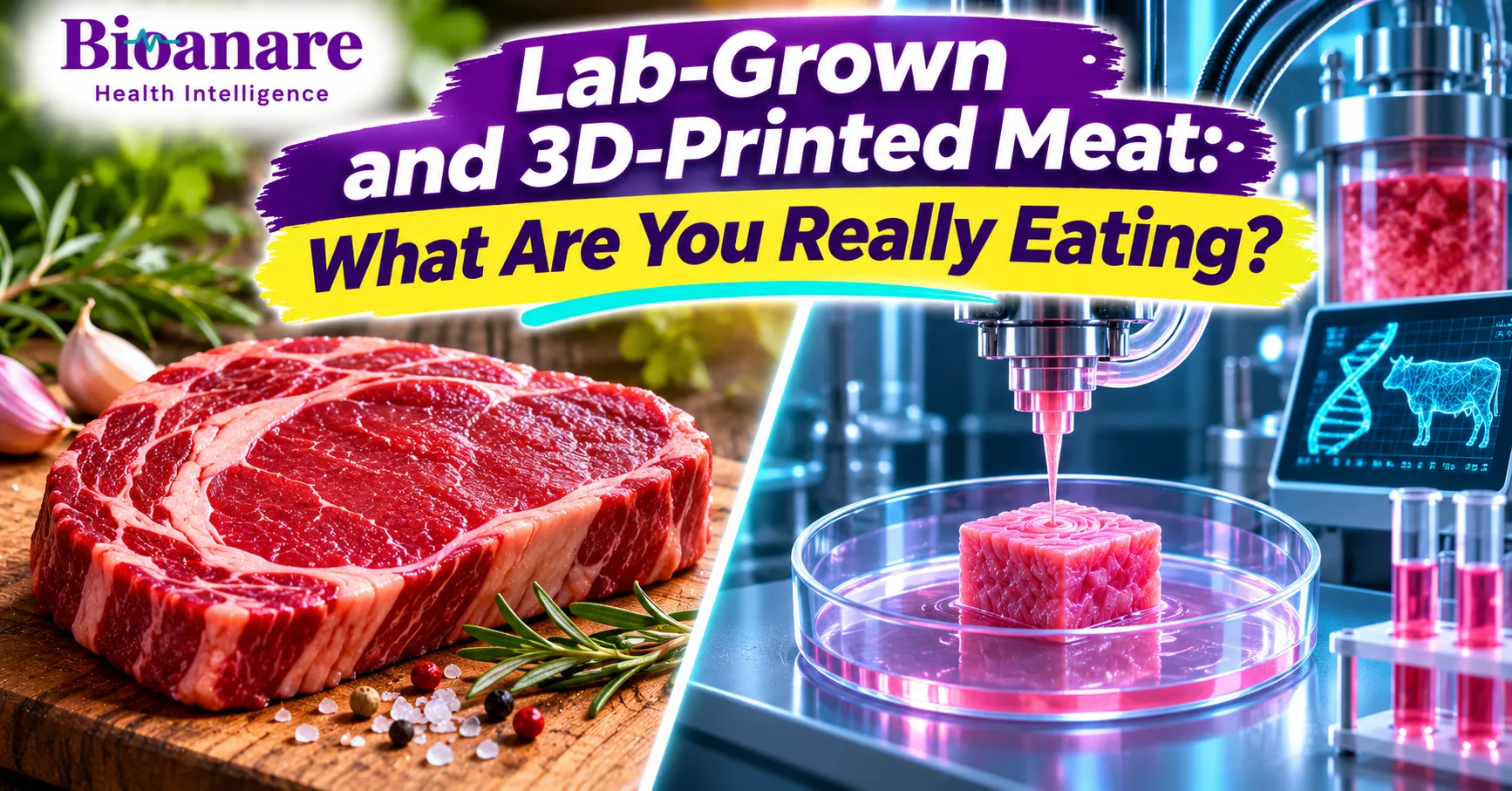
It's being sold as the future of food — sustainable, humane, identical to real meat. But lab-grown meat and 3D-printed fish are products that have never existed in the human diet before. They are grown from animal stem cells in bioreactors, structured on artificial scaffolds, and fed on growth media formulas that differ fundamentally from the biological environment inside a living animal.
The question is not whether this is clever technology. It is: what happens to your body when you eat it over years or decades? Nobody knows. And that is a serious problem.
Upload your blood test to Bioanare — free 7-day trial, no credit card required
How Is Lab-Grown Meat Made?
Cultured meat — also called cultivated meat or lab-grown meat — starts with cells taken from a living animal (a biopsy). Those cells are then:
- Placed in a growth medium — a liquid formula containing nutrients, sugars, amino acids, and in many cases growth factors derived from fetal bovine serum (FBS), taken from unborn calves
- Grown in bioreactors — large industrial tanks where cells multiply under controlled conditions
- Scaffolded — structured using 3D printing or other techniques to create texture that resembles real muscle tissue
3D-printed meat takes this further: cells are loaded into a bio-ink and extruded layer by layer through a printer nozzle, building up a cut of "meat" that mimics the structure of real muscle.
What the Research Actually Shows
A study comparing lab-grown chicken to conventional chicken found that lab-grown meat had less protein, lower amounts of most essential amino acids, less magnesium, and less vitamin B3. The nutritional profile is similar on the surface but not identical — and those differences compound over a lifetime of eating.
The UK Food Standards Agency's hazard identification report on cultured meat identified multiple risk categories:
- Contamination risks: bioreactor environments require strict sterility — any contamination with bacteria, fungi, or viruses creates a food safety hazard at scale
- Genetic instability: cells grown over long periods may accumulate genetic mutations — the implications for the person eating them are unknown
- Growth media residues: the chemicals used to stimulate cell growth may remain in the final product
- Novel allergens: cultured meat may trigger immune responses that conventional meat does not, because the protein profile is not identical
- Scaffold material safety: the artificial structures used to give lab-grown meat its texture are made from materials that have not been in the human food supply before
The Fetal Bovine Serum Problem
Most commercial cultured meat production still relies on fetal bovine serum (FBS) — blood extracted from fetal calves during slaughter. FBS contains a complex mixture of growth hormones, proteins, and other biological compounds. When it is used as the growth medium for cells that become your food, questions arise about what residues transfer into the final product — and what long-term hormonal effects those residues might have.
What About 3D-Printed Fish?
Lab-grown fish and seafood present additional complexity. Fish have highly specific nutritional profiles — particularly omega-3 fatty acid content — that depend entirely on what the fish ate and how it lived. A cell-grown fish fillet grown in a bioreactor on a synthetic medium will have a different omega-3 profile than a wild-caught fish. The difference may be significant.
Zero Long-Term Human Studies
Here is the central fact that is not being discussed in mainstream coverage: there are no long-term human safety studies on the consumption of cultured meat. The products were approved in the US in 2023 based on short-term food safety tests. There is no data on what happens to the human gut microbiome, immune system, hormonal regulation, or metabolic health after years of eating food that was never part of the human evolutionary diet.
We have been in this position before — with margarine (promoted as healthier than butter for decades before the trans fat disaster), with processed seed oils, with artificial sweeteners. The pattern is consistent: novel food products are introduced as safe, mass-adopted, and the harm becomes apparent a generation later.
What You Can Do Now
- Avoid lab-grown meat and 3D-printed seafood products until long-term safety data exists
- Read labels — cultured meat will be labeled in the US and EU, though labeling rules vary
- Choose wild-caught fish and pasture-raised animal products where possible
- Understand that "sustainable" and "safe" are not the same claim
Bioanare provides educational health information only. This is not a medical diagnosis. Always consult a qualified healthcare professional before making any health decisions.
← Back to all articles