
Petroleum in Your Vegetable Oil: The Contamination Nobody Talks About
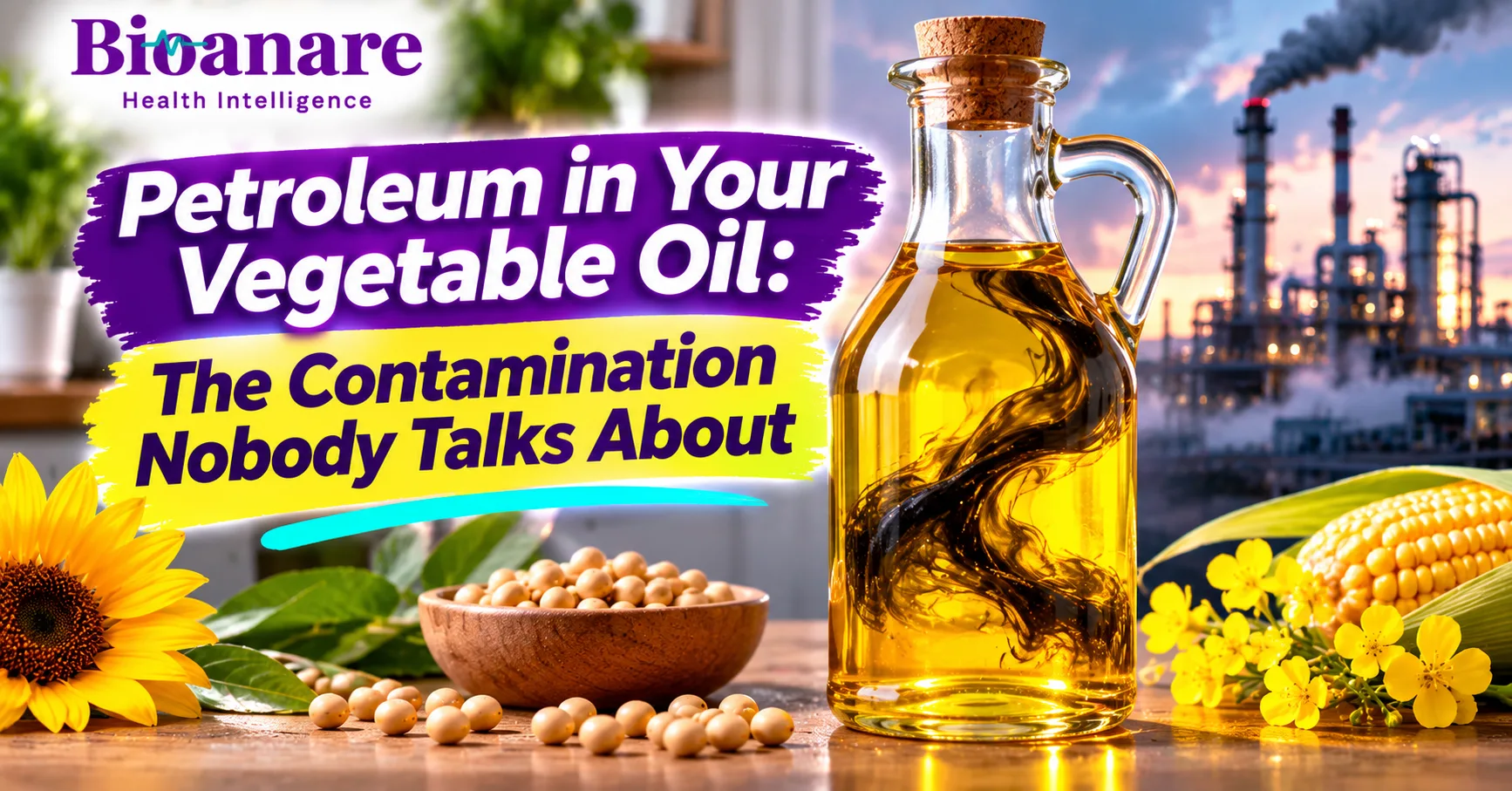
You reach for a bottle of vegetable oil expecting plant-derived fat. What you may also be getting — and what the label will never mention — are mineral oil hydrocarbons: chemical compounds derived from the distillation and refining of crude petroleum.
This is not a theory. It is documented by the European Food Safety Authority (EFSA), reviewed in peer-reviewed journals, and monitored by food safety agencies across the EU. Vegetable oils consistently test as among the most contaminated foods in terms of mineral oil hydrocarbon (MOH) content.
Upload your blood test to Bioanare — free 7-day trial, no credit card required
What Are Mineral Oil Hydrocarbons?
Mineral oil hydrocarbons (MOH) are a broad group of chemical compounds that originate primarily from petroleum. They are divided into two main categories:
MOSH (Mineral Oil Saturated Hydrocarbons): These accumulate in human tissue — particularly the liver and lymphoid system. Long-term accumulation effects are still being studied.
MOAH (Mineral Oil Aromatic Hydrocarbons): More concerning. Some MOAH compounds are genotoxic — meaning they can damage DNA. For genotoxic substances, regulators acknowledge that no safe exposure level can be established.
How Do They Get Into Vegetable Oil?
MOH contamination enters the food supply through multiple pathways:
- Industrial machinery lubricants used in harvesting and processing equipment
- Recycled cardboard packaging — mineral oils from printing inks migrate through cardboard into the food inside
- Processing aids and release agents used during oil extraction
- Environmental contamination of crops near industrial areas
- Jute bags used to transport seeds, often treated with mineral oil
The refining process that converts raw plant material into the clear, neutral vegetable oil on your shelf — involving high heat, chemical solvents, bleaching, and deodorization — does not remove MOH contamination. It may concentrate it.
Which Oils Are Most Affected?
EFSA's monitoring found the highest MOH levels in:
- Sunflower oil
- Rapeseed oil (canola)
- Palm oil
- Soybean oil
- Mixed vegetable oils
These are precisely the oils used most heavily in processed foods, restaurant frying, and commercial cooking.
The Adulteration Problem
Separate from MOH contamination, vegetable oil fraud is widespread. Investigations in multiple countries have found oils labeled as premium single-variety oils (sesame, groundnut) blended with 70% or more cheap palm oil — with added flavor compounds to mask the substitution. The EU has set maximum MOSH limits in vegetable oil, but enforcement and testing are inconsistent.
What the Regulators Say — And Don't Say
EFSA's official position (updated 2022): MOSH at current dietary exposure levels do not present a public health risk — but long-term effects require further study. For MOAH (the genotoxic fraction), EFSA acknowledges concern cannot be ruled out and that more data is needed on 3-ring and larger MOAH compounds.
Translation: the regulators know there's a problem. They are still studying how big it is. Meanwhile, you consume these oils every day.
What You Can Do
- Choose cold-pressed, unrefined oils — lower processing means less opportunity for contamination and concentration of MOH
- Use extra virgin olive oil (authentic — see our guide to spotting fake olive oil) for cold applications
- Use butter, ghee, or coconut oil for high-heat cooking — these are not associated with the same MOH contamination pathways
- Minimize processed food consumption — the majority of MOH dietary exposure comes from processed foods that use refined vegetable oils
- Avoid oils in soft plastic bottles — plastic packaging increases migration of contaminants
The issue is not that vegetable oil is inherently toxic. It is that the vegetable oil on most supermarket shelves has been processed, transported, stored, and packaged in ways that introduce petroleum-derived compounds into your diet — compounds that accumulate in your organs and whose long-term effects have not been fully characterized.
Bioanare provides educational health information only. This is not a medical diagnosis. Always consult a qualified healthcare professional before making any health decisions.
← Back to all articles