
Why Food Has More Chemicals Today Than 30 Years Ago
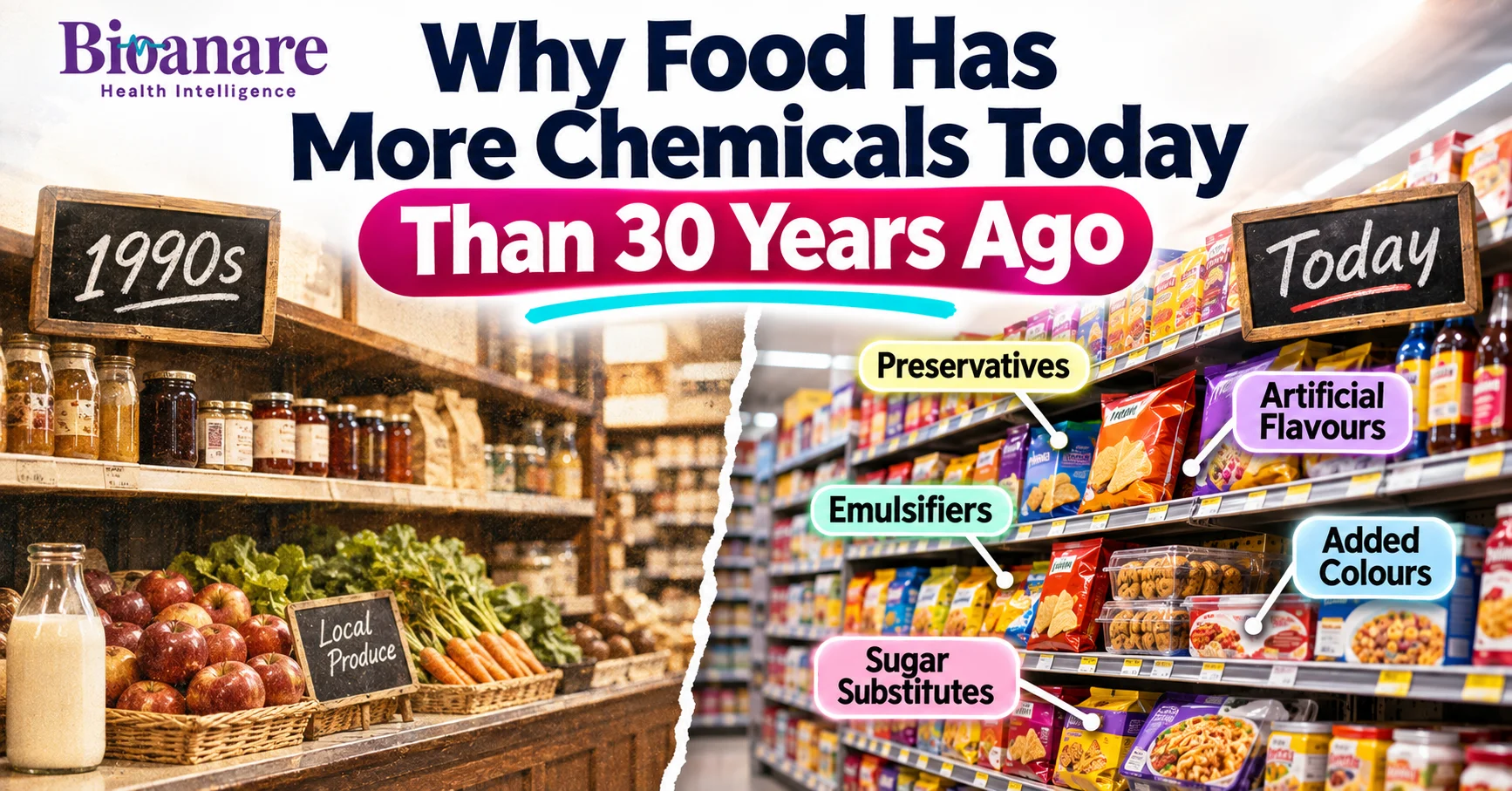
Compare the ingredient list of a loaf of bread from 1990 with one from today. In 1990: flour, water, yeast, salt. Today: flour, water, yeast, salt, dough conditioners, emulsifiers, calcium propionate, ascorbic acid, azodicarbonamide, monoglycerides, DATEM, modified corn starch...
This isn't just bread. It's nearly every category of processed food.
Upload your blood test to Bioanare — free 7-day trial, no credit card required
What Changed?
1. The rise of industrial food production. Food is now manufactured at massive scale, transported across continents, and expected to stay fresh for months. Each step in that chain requires more chemical intervention to maintain stability, texture, and appearance.
2. Fat was demonized. Following the flawed fat-hypothesis of the 1970s and 80s, food manufacturers removed fat from products. Fat carries flavor. When fat was removed, sugar and artificial flavors were added to compensate. This triggered an explosion of manufactured ingredients designed to replace natural taste.
3. Food regulatory systems have a time lag. New additives can be introduced to the food supply and approved under "generally recognized as safe" (GRAS) status — sometimes without independent testing, based on industry-submitted data. The long-term cumulative effects of multiple additives consumed daily over decades are rarely studied.
4. Consumer demand for convenience. Ready meals, shelf-stable products, and 12-month expiry dates require preservatives, stabilizers, and packaging technologies that didn't exist 30 years ago.
5. Ultra-processing became the norm. The NOVA food classification distinguishes minimally processed foods from ultra-processed foods (UPFs) — products manufactured using industrial processes and ingredients with no home-kitchen equivalent. Research published in the British Medical Journal, The Lancet, and JAMA consistently associates UPF consumption with higher rates of obesity, type 2 diabetes, cancer, cardiovascular disease, and depression.
What You Can Do
Reduce ultra-processed foods. Shop the perimeter of the grocery store. Cook from recognizable ingredients. If you can't pronounce it and wouldn't find it in a home kitchen, reconsider it.
Bioanare provides educational health information only. This is not a medical diagnosis. Always consult a qualified healthcare professional before making any health decisions.
← Back to all articles